Top 10 Microsoft Azure Alternatives for Cloud Apps in 2026

Manager, Content Marketing
- Updated:
- 25 min read
Microsoft Azure is a cloud computing platform that enables companies to host applications, store data, run virtual machines, and manage their IT infrastructure without maintaining physical servers. Alongside Google Cloud and AWS, it belongs to a class of hyperscaler clouds that collectively control over 60% of the global cloud market, according to 2025 data from Statista. That scale comes with complexity. Navigating Azure’s vast catalog of services often requires specialized certifications (like Azure Fundamentals), and its pricing models can be opaque with hidden costs for bandwidth, support tiers, and services you didn’t realize you were using.
Specialized providers, such as DigitalOcean, cater better to the needs of digital-native enterprises and AI startups. Your business gets straightforward pricing, faster deployment times, and infrastructure designed for developer velocity (rather than enterprise workflows). Beyond cloud computing and infrastructure offerings like managed Kubernetes, block storage, and load balancers, many specialized providers also have AI products to help you build AI/ML features into your projects: from cloud GPUs to managed AI services to managed vector databases. Read on for a closer look at Azure alternatives that offer enterprise-grade capabilities—without the enterprise-grade headaches.
Key takeaways:
-
Microsoft Azure is a cloud computing platform that belongs to the hyperscaler class alongside AWS and Google Cloud, which collectively control over 60% of the global cloud market, but each comes with significant complexity and often opaque pricing.
-
The benefits of cloud providers (over physical infrastructure) include elastic scalability to handle traffic spikes, global data center coverage for lower latency, pay-as-you-go pricing that eliminates upfront hardware costs, managed services that handle maintenance and security, and faster time to market since you can spin up new environments in hours instead of weeks.
-
When evaluating cloud providers, prioritize cost efficiency and transparent pricing, security and compliance certifications, performance and reliability guarantees, scalability options, data management capabilities, customer support quality, SLAs, and ecosystem integrations.
-
Alternative providers that offer simpler interfaces and more transparent pricing include DigitalOcean, Linode (now Akamai Cloud), Vultr, OVHcloud, Scaleway, and Hetzner; hyperscaler options beyond Azure include Amazon Web Services (AWS), Google Cloud Platform (GCP), IBM Cloud, and Alibaba Cloud.
What is Microsoft Azure?
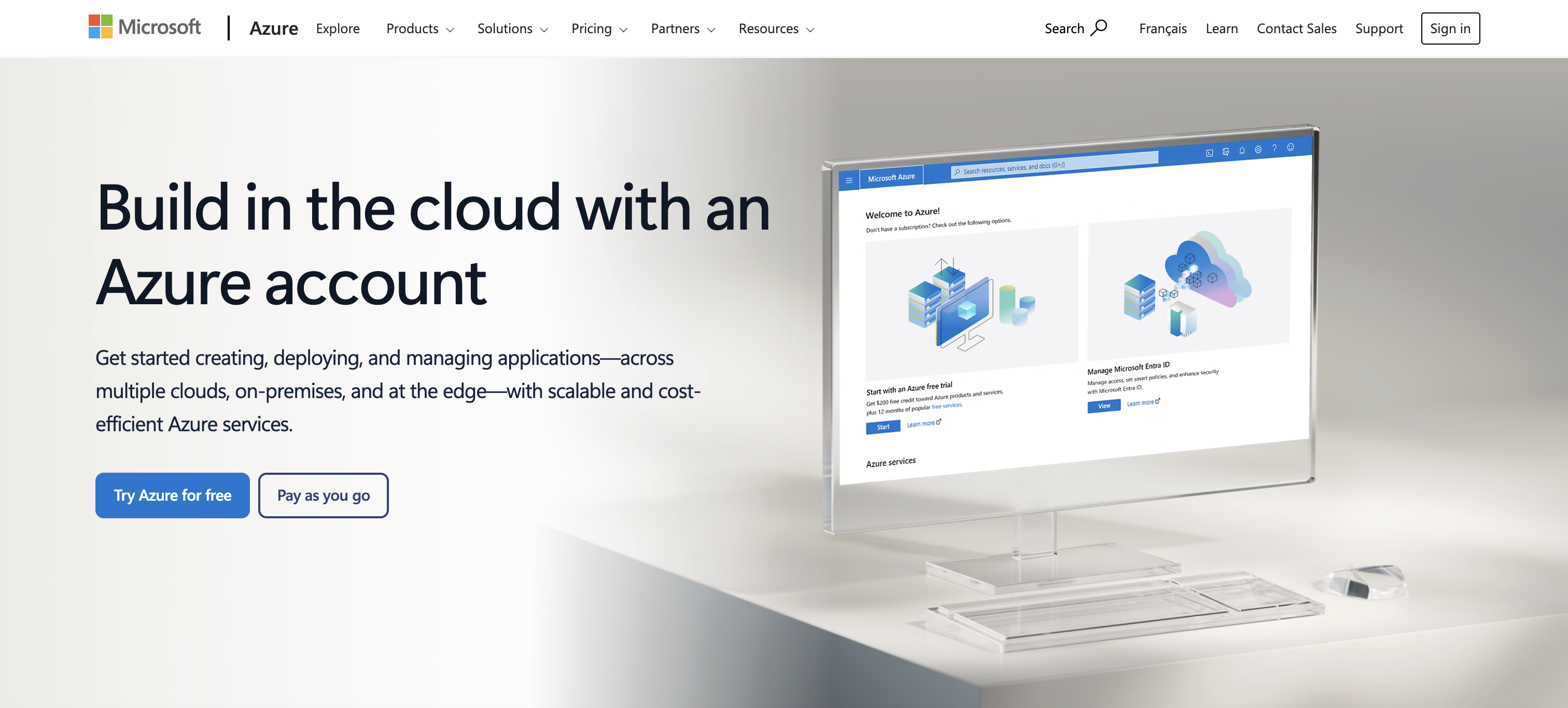
Launched in 2010, Azure has grown to become the second-largest cloud provider globally, holding approximately 20% of the cloud infrastructure market as of Q3 2025. Its cloud computing platform lets businesses build, deploy, and manage applications and infrastructure through Microsoft’s global network of 400 data centers across 70 regions. Their product lineup includes everything from virtual machines and storage to AI and machine learning tools.
Microsoft Foundry is the company’s AI platform with access to over 11,000 models. Its capabilities span from agent development and video generation with Sora to image creation, speech-to-text, and fine-tuning services across popular models from xAI, Cohere, Meta, and Mistral AI.
Microsoft Azure key features:
-
Multiple VM series from entry-level B-series to high-performance instances with up to 64 cores and 256 GB RAM, running on Intel, AMD, and ARM-based processors
-
NVIDIA-powered GPU instances, including H100, A100, and Blackwell GB300 series, for AI training and inference with InfiniBand networking for supercomputing-scale deployments
-
Azure Kubernetes Service (AKS), Container Apps with serverless GPU support, and Container Instances for flexible orchestration with automatic scaling
Microsoft Azure pricing:
-
Virtual machines: $6.132/month for basic B2ts v2 series (pay-as-you-go pricing)
-
Azure App Service: $0 for F1 Free Plan; $9.49/month per site for D1 Shared Plan
-
Cloud GPUs (H100): $8.820/hour for NC40ads H100 v5 with 40 vCPUs, 320 GB RAM, 3576 GB temporary storage
Drowning in Azure’s overwhelming complexity, but only need straightforward cloud infrastructure? Discover Azure alternatives that strip away the maze of unnecessary features and deliver transparent pricing, intuitive management, and the core services your business actually makes use of—without the enterprise bloat. Plus, get a rundown of DigitalOcean vs Azure.
Benefits of cloud providers
Working with cloud providers, you don’t need to purchase, maintain, and upgrade physical infrastructure. Instead of managing servers, your team can laser-focus on building the next big thing. From handling traffic spikes to running complex AI training jobs, here’s why the infrastructure-as-a-service model is ideal:
-
Elastic scalability: Cloud providers allow you to scale compute, storage, and network resources up or down within minutes, automatically adjusting to traffic patterns. This cloud elasticity means you can handle sudden traffic spikes during product launches, without over-provisioning expensive hardware that sits idle during quieter periods.
-
Global infrastructure: Major cloud providers operate data centers across dozens of regions worldwide, so you can deploy applications closer to your users for lower latency and better performance. This geographic distribution also supports cloud compliance requirements by allowing you to store data within specific jurisdictions.
-
Pay-as-you-go economics: Instead of large upfront capital expenditures on servers and networking equipment, cloud pricing operates on a consumption basis. You only pay for the resources you actually use.
-
Managed services and automation: Cloud providers like DigitalOcean handle infrastructure maintenance, security patches, hardware failures, and network management—you get to skip the operational overhead. These platforms also offer managed databases, container orchestration, serverless computing, and AI/ML services.
-
Faster time to market: Developers can provision new environments, deploy applications, and experiment with different architectures in hours rather than weeks (or longer). No more waiting on hardware orders, rack installations, or network configurations before you can start building.
What to look for in a cloud provider
The right cloud provider should align with your actual needs: what you’re building, what you can afford, the regulations you need to follow, and where you’re headed. Getting clear on these things up front saves you from time-consuming (and expensive) cloud migrations down the road. Here’s what to look for as you assess options:
-
Cost efficiency and pricing structure: Look for transparent pricing models that clearly outline costs for compute, storage, and network egress, without hidden costs or surprise charges. Evaluate whether the provider offers flexible pricing options like reserved instances, spot instances, savings plans, and per-second billing that can reduce costs for predictable workloads.
-
Security and compliance: The provider should offer security features, including encryption at rest and in transit, identity and access management, network isolation through VPCs, and DDoS protection as standard capabilities. Verify that they maintain compliance certifications (SOC 2, ISO 27001, HIPAA, GDPR, etc.) and provide tools for audit logging, security cloud monitoring, and vulnerability scanning.
-
Performance and reliability: Assess the provider’s infrastructure quality, including processor generations, network backbone speed, storage IOPS capabilities, and GPU availability for compute-intensive workloads. Their track record on uptime, incident response times, and whether they offer multi-availability zone deployments and automated failover mechanisms are all worth checking.
-
Scalability and flexibility: The platform should support both vertical scaling (upgrading instance sizes) and horizontal scaling (adding more instances) with minimal downtime or configuration complexity. Look for auto-scaling capabilities, load balancing options, and the ability to quickly provision resources across different regions as your application demands change.
-
Data management: Evaluate the provider’s storage options, including object storage, block storage, and managed databases, as well as their backup, replication, and cloud disaster recovery capabilities. You’ll also want to consider the data transfer costs between regions and the ease of migrating data in and out of the platform.
-
Customer support: Determine what support tiers are available, response time commitments for different severity levels, and whether you have access to technical account managers or solution architects. Documentation quality, community forums, training resources, and 24/7 support across your team’s time zones all matter, too.
-
Service level agreements (SLAs): Review the provider’s uptime guarantees (typically ranging from 99.9% to 99.99% for different service tiers) and understand the compensation or service credits you receive if they fail to meet their commitments. Pay attention to what’s actually covered—some SLAs only apply to specific services or exclude scheduled maintenance windows.
-
Ecosystem and integration capabilities: A good provider offers a marketplace of pre-built integrations, third-party tools, and managed services that complement their core infrastructure offerings. Look for strong API support, infrastructure-as-code tools (Terraform, CloudFormation), CI/CD pipeline integrations, and compatibility with popular development frameworks and monitoring solutions your team already uses.
Take control of your cloud spending with a billing dashboard that shows exactly what you’re paying for and why. From setting billing alerts to viewing detailed invoice breakdowns, managing your costs is simple and transparent.
Top 10 Microsoft Azure alternatives in 2026
Whether you’re looking to fully migrate away from Azure or adopt a multi-cloud strategy to avoid vendor lock-in, you have numerous Azure alternatives to choose from. These options range from specialized providers focused on developer experience and cost efficiency to other hyperscalers.
| Solution | Best for (use case) | Key features | Pricing |
|---|---|---|---|
| Microsoft Azure | Enterprise-scale AI and hybrid deployments | Virtual machines, NVIDIA GPU instances (H100, A100, Blackwell GB300), Azure Kubernetes Service (AKS), Container Apps, Microsoft Foundry AI platform | VMs from $6.13/mo; App Service free (F1) or from $9.49/mo; GPU from $8.82/hr |
| DigitalOcean | Startups and digital native enterprises | Droplets, Managed Databases, Managed Kubernetes, App Platform, 200+ 1-Click Apps, GPU Droplets (H100, H200, MI300X) | Droplets from $4/mo; App Platform free (static sites) or from $5/mo; GPU from $1.99/hr |
| Linode (Akamai Cloud) | Developer-friendly Linux infrastructure | VMs, Object Storage, Managed Databases (MySQL, PostgreSQL), LKE, Akamai App Platform, RTX 4000 Ada GPUs | Compute from $5/mo; App Platform free; GPU from $0.52/hr |
| Vultr | High-performance VPS and GPU computing | Cloud Compute, Object Storage, Managed Databases, VKE, NVMe SSD, fractional GPU via MIG, H100/H200/A100/MI300X GPUs; no native PaaS | Compute from $5/mo; GPU from $2.99/hr |
| OVHcloud | European data residency and GDPR compliance | Public Cloud, Object Storage, Managed Databases, Managed Kubernetes, bare metal, vRack networking, 10 Tbps DDoS protection; no native PaaS | Instances from $8.59/mo; GPU from $4.59/hr |
| Scaleway | Sustainable, sovereign European cloud | Virtual Instances, Object Storage, Managed Databases, Managed Kubernetes, Serverless platform, Elastic Metal, 100% renewable energy; no native PaaS | Instances from €0.10/mo; GPU from €2.52/hr |
| Hetzner | Budget-conscious self-managed infrastructure | Cloud Servers, Block Storage, Object Storage, Load Balancers, dedicated GPU servers; no managed databases, Kubernetes, or PaaS | Servers from $4.09/mo; dedicated GPU from $205/mo + $88 setup (bare metal only, no on-demand cloud GPUs) |
| AWS | Enterprise-scale feature depth | 200+ services, EC2, S3, RDS, EKS, App Runner, Bedrock, SageMaker, P5 GPU instances (8x H100) | EC2 from $6.13/mo; App Runner from $0.007/vCPU-hr; GPU from $6.88/hr |
| GCP | Data analytics and machine learning | Compute Engine, Cloud Storage, Cloud SQL, GKE, Cloud Run, App Engine, Vertex AI, BigQuery, BigQuery Omni | Compute from $6.11/mo; App Engine from $0.05/hr; GPU from $88.49/hr |
| IBM Cloud | Regulated industries and hybrid deployments | Virtual Servers, Cloud Object Storage, Managed Databases, Kubernetes, Code Engine, watsonx.ai | VMs from $53.29/mo; GPU from $85/hr |
| Alibaba Cloud | Asia-Pacific market reach | ECS, OSS, ApsaraDB, ACK, SAE, Function Compute, Platform for AI, Qwen models | ECS from $4.55/mo; SAE from $6.85/yr; GPU from $2.26/hr |
Specialized providers
Specialized providers sit outside the hyperscaler ecosystem, offering cloud infrastructure tailored for digital-native enterprises, startups, and developers—though often with the capabilities to service large enterprises as well. These platforms prioritize simplicity and speed, with simple interfaces, straightforward pricing models, and curated service catalogs that eliminate the overwhelming complexity of navigating thousands of products.
1. DigitalOcean for startups and digital-native enterprises
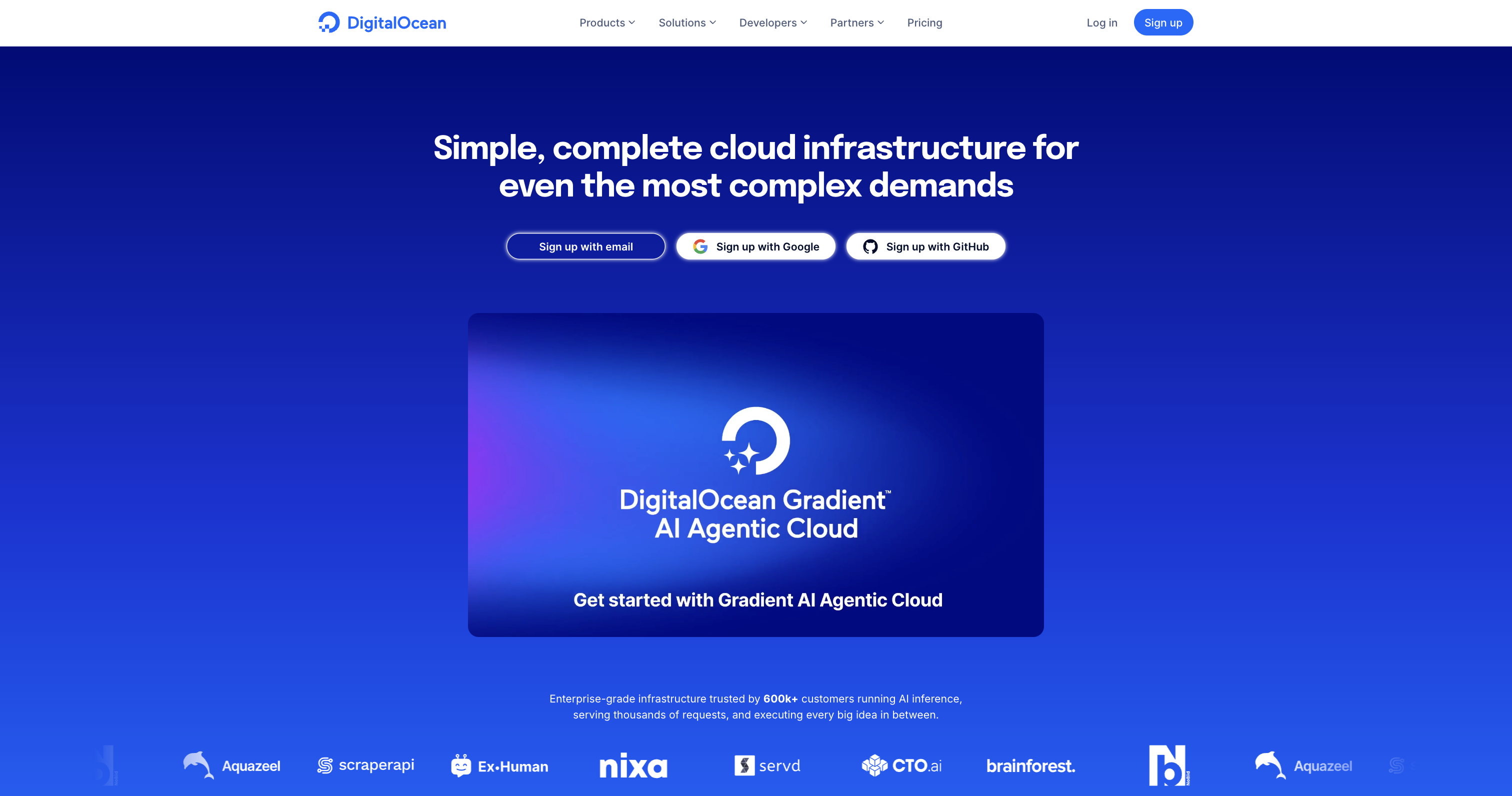
DigitalOcean is a cloud infrastructure provider that has built its reputation on simplicity, transparent pricing, and fast deployment times for digital-native enterprises. Developers and startups gravitate toward DigitalOcean for its intuitive control panel, excellent documentation, and pricing that includes free bandwidth allowances—eliminating the surprise egress fees and complex billing structures common with Azure, AWS, and Google Cloud. The platform offers a comprehensive suite of cloud computing services, including Droplets (virtual machines), Spaces Object Storage, Managed Databases (PostgreSQL, MySQL, MongoDB, Redis, Kafka), Managed Kubernetes, and App Platform for deploying applications directly from Git repositories without managing infrastructure. The DigitalOcean Marketplace features over 200 preconfigured 1-Click Apps—from WordPress and Ghost to LAMP stacks, Docker, and monitoring tools like Grafana—so you can deploy fully tested environments in minutes instead of hours.
DigitalOcean’s AI capabilities center on the Gradient™ AI Agentic Cloud, which provides GPU Droplets powered by NVIDIA H100, H200, and AMD MI300X processors, Bare Metal GPUs for multi-node clusters, and the Gradient™ AI Platform for building AI agents with knowledge bases and agent routes.
DigitalOcean key features:
-
NVMe SSD storage with up to 10 Gbps network speeds, CPU configurations up to 32 cores with 256 GB RAM
-
Pre-installed AI/ML frameworks (Python, Torch, CUDA) on GPU instances with 640 Tensor Cores and 128 RT Cores per H100 GPU
-
Free control plane for Kubernetes with automatic updates, patching, and integrated GPU worker node support
-
Global infrastructure across 16 data centers in 9 regions with 99.99% uptime SLA, VPC networking, free always-on DDoS protection, cloud firewalls, and compliance certifications including SOC 2 Type II, SOC 3 Type II, HIPAA, and GDPR
DigitalOcean pricing:
-
Droplets: $4/month starting for basic VMs with 512 MiB memory, 1 vCPU, 10 GiB SSD, and 500 GiB transfer
-
App Platform: $0 for static sites; $5/month starting for basic web apps with automatic scaling and built-in CI/CD
-
GPU Droplets: $3.39/GPU/hour on-demand for NVIDIA H100 GPU instances, or $1.99/GPU/hour with a 12-month commitment
2. Linode (now Akamai Cloud) for developer-friendly Linux infrastructure

Linode is a developer-focused cloud infrastructure provider that delivers Linux-based virtual private servers. It now operates as Akamai Connected Cloud following its $900 million acquisition by Akamai Technologies in 2022. The platform offers a straightforward alternative to hyperscaler complexity, appealing to developers and startups that prioritize transparent pricing and simplicity over sprawling service catalogs. Linode offers virtual machines in Shared CPU, Dedicated CPU, High Memory, and Premium CPU configurations, along with S3-compatible Object Storage, Managed Databases for MySQL and PostgreSQL, and Managed Kubernetes Engine (LKE) for containerized workloads. For your platform-as-a-service (PaaS) needs, the Akamai App Platform provides a pre-built Kubernetes developer platform with integrated CI/CD tools (Argo CD, Gitea, Harbor, Knative), built-in observability and security, and self-service deployment for containerized applications.
Have AI and machine learning workloads? Linode also provides GPU instances powered by NVIDIA RTX 4000 Ada Generation GPUs and NVIDIA Quadro RTX 6000 GPUs, supporting TensorFlow, PyTorch, and other ML frameworks for tasks like model training, AI inferencing, and big data analysis.
Linode key features:
-
Compute instances come with multi-queue NIC support on 2+ vCPU plans, instant resizing capabilities, and one-click marketplace deployments
-
RTX 4000 Ada GPUs deliver 6,144 CUDA cores and 192 Tensor Cores per card with dual encode/decode engines and AV1 codec support
-
Linode Kubernetes Engine offers automated node recovery, free control plane management, GPU node pool integration, and consumption-based pricing with no control plane fees
-
The platform includes automated daily and weekly backups with point-in-time recovery, VPC private networking, NodeBalancers for load balancing, and integrated cloud firewalls
Linode pricing:
-
Compute: $5/month starting for Nanode 1 GB Shared CPU with 1 GB RAM, 1 CPU, 25 GB storage, and 1 TB transfer
-
Akamai App Platform: $0 (free); runs on LKE infrastructure with consumption-based pricing for underlying compute resources
-
GPU Instances: $0.52/hour ($350/month) for RTX 4000 Ada; $1.50/hour ($1,000/month) for Quadro RTX 6000
Since Akamai’s 2022 acquisition, Linode’s pricing structure has evolved—but not always in ways that benefit smaller teams. Discover which Linode alternatives offer better GPU access, lower egress fees, and the developer-focused simplicity that originally made Linode popular.
3. Vultr for no-frills global cloud infrastructure
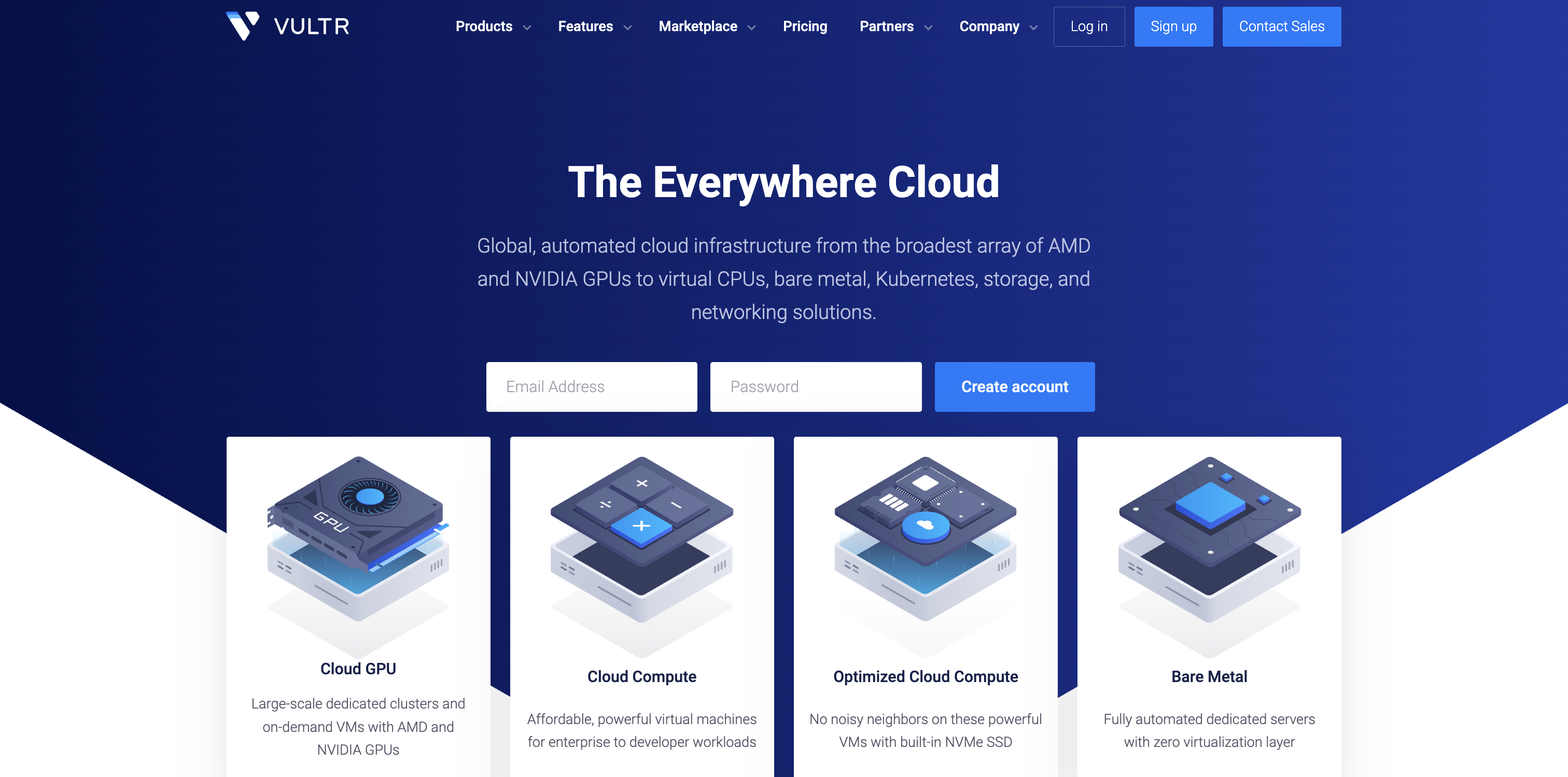
Vultr is a cloud infrastructure provider founded in 2014 that has built its reputation on delivering high-performance virtual private servers and GPU computing. The platform provides simplicity and cost efficiency while maintaining enterprise-grade infrastructure capabilities. Vultr offers Cloud Compute instances with shared and dedicated CPU configurations (including High Performance, High Frequency, and VX1 plans), S3-compatible Object Storage, Managed Databases for MySQL, PostgreSQL, Apache Kafka, and Valkey, and Vultr Kubernetes Engine (VKE) with a free control plane. Vultr lacks a native PaaS service, opting instead to integrate with third-party providers like Cloud 66 through its Cloud Alliance marketplace, adding complexity if you’re looking for a unified platform experience.
Vultr’s GPU catalog includes NVIDIA H100, H200, A100, L40S, and AMD Instinct MI300X and MI325X GPUs, available as virtual machines or bare metal servers with support for TensorFlow, PyTorch, and other ML frameworks for training, inference, and HPC applications.
Vultr key features:
-
NVMe SSD storage across all compute plans, instant provisioning in under 60 seconds, KVM virtualization with full root access, and one-click marketplace apps
-
Fractional GPU allocation via MIG technology for cost-effective AI inference and training workloads
-
CNCF certification for portability, Cluster API support, and an integrated Cloud Controller Manager for automatic load balancer provisioning
-
DDoS protection included, customizable cloud firewalls, Virtual Private Cloud networking, automated snapshots and backups, and BGP announcements for IP space across all global locations
Vultr pricing:
-
Cloud Compute: $5/month starting for Shared CPU with 1 GB RAM, 1 vCPU, 25 GB SSD
-
GPU instances: 2.99/hour on-demand for NVIDIA H100 GPU instances
Without 24/7 support options or managed databases for MongoDB and Kafka, Vultr’s limitations become apparent as applications scale. See which Vultr alternatives offer the support tiers, broader managed services, and uptime guarantees that production workloads require.
4. OVHcloud for European data residency and GDPR compliance
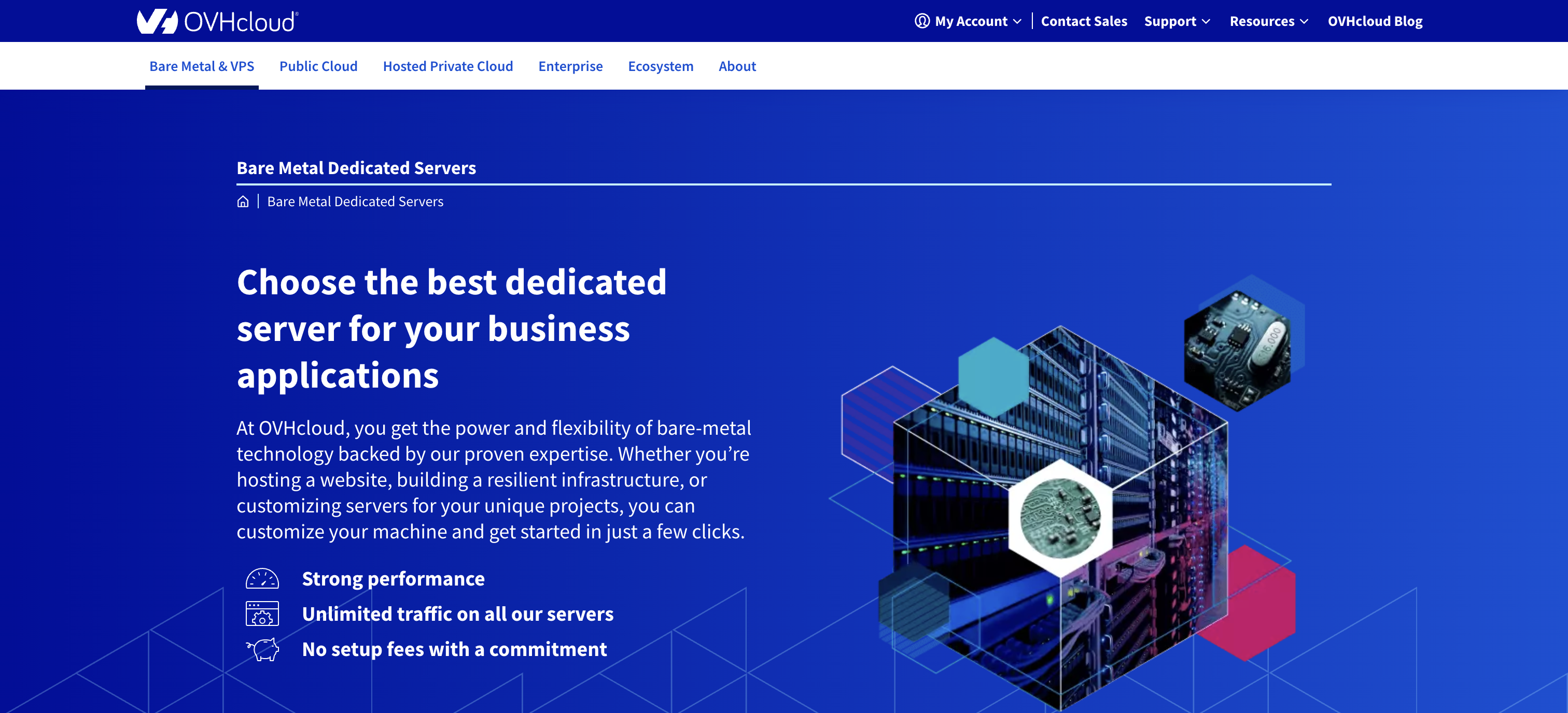
OVHcloud has grown to become the largest hosting provider in Europe. The platform serves businesses prioritizing European data residency, transparent pricing, and avoiding vendor lock-in, particularly appealing to companies navigating GDPR requirements or seeking alternatives to the U.S.-based cloud providers. OVHcloud offers Public Cloud Instances (virtual machines) in flexible and fixed configurations, Object Storage with S3 compatibility, Managed Databases for MySQL, PostgreSQL, MongoDB, Redis, and Kafka, Managed Kubernetes Service, and bare metal dedicated servers that provide direct hardware access without virtualization overhead. Similar to Vultr, OVHcloud does not have a dedicated PaaS offering; however, it partners with Platform.sh (now rebranded as Upsun) to provide application platform-as-a-service capabilities.
OVHcloud provides AI Training and AI Notebooks built on GPU infrastructure, including NVIDIA V100, A100, and H100 GPUs, supporting popular ML frameworks like TensorFlow, PyTorch, and Hugging Face Transformers with pay-per-use pricing and integration with OVHcloud’s object storage for dataset management.
OVHcloud key features:
-
Bare metal and Public Cloud instances running on Intel Xeon and AMD EPYC processors with NVMe SSD storage, up to 120 vCPUs and 500 GB RAM per instance, 99.99% SLA with multi-AZ redundancy
-
Portability tools for migrating workloads in and out without vendor-specific dependencies
-
Private networking with vRack technology, providing Layer 2 isolation across multiple OVHcloud products
-
DDoS protection up to 10 Tbps is included on all services, and load balancers with automatic SSL certificate management
OVHcloud pricing:
-
Public Cloud Instances: $8.59/month starting for shared-resource instances with 2 GB RAM, 1 vCore, and 25 GB storage
-
AI Training GPUs: $4.59/hour starting for NVIDIA H100 GPU instances
With complex pricing structures and limited developer-focused features, OVHcloud’s European strengths may not translate to global deployments. Learn which OVHcloud alternatives deliver the transparent pricing, intuitive tooling, and worldwide data center coverage that scaling applications need.
5. Scaleway for sustainable, sovereign European cloud
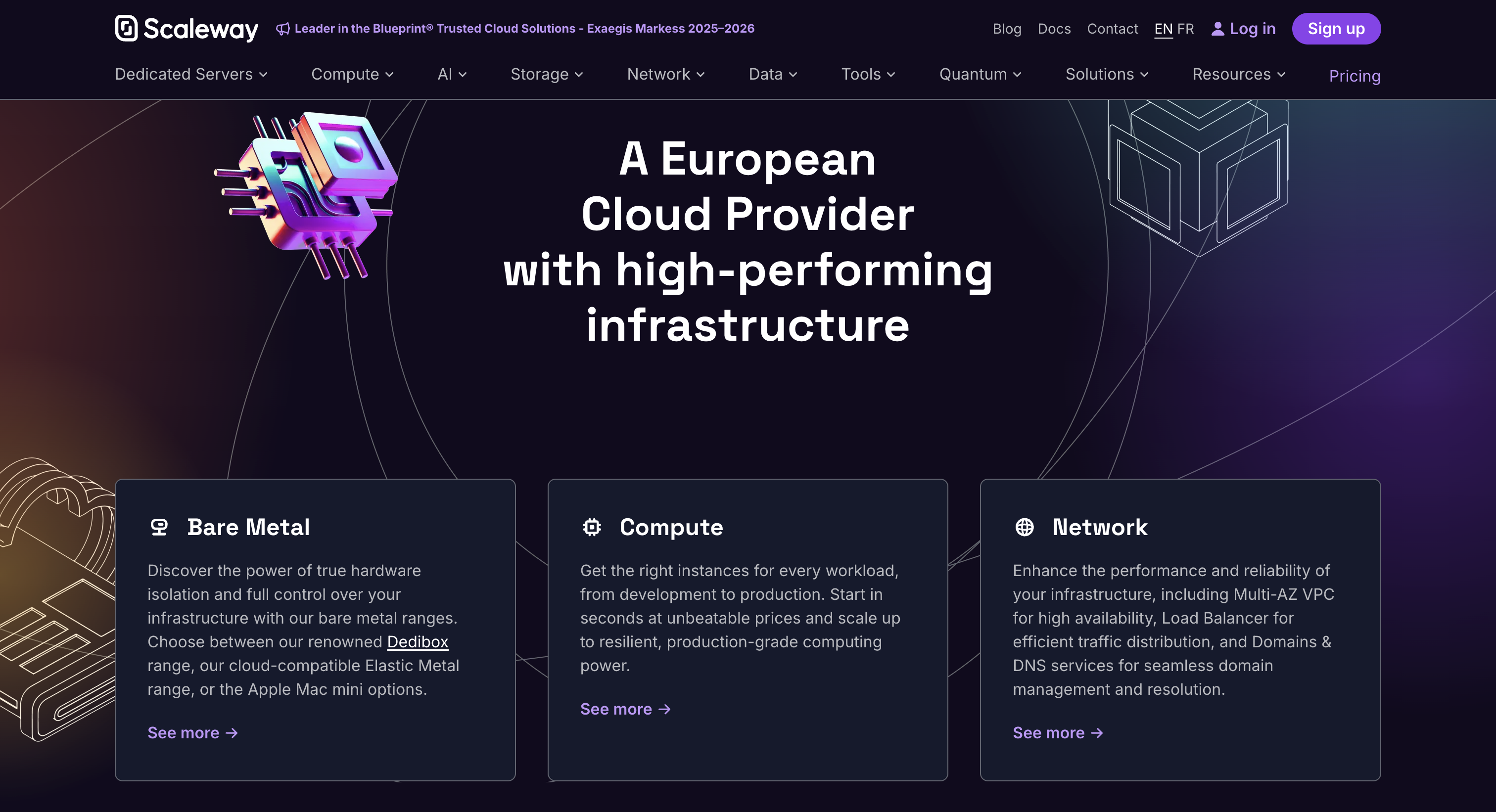
Scaleway is a French cloud infrastructure provider, positioning itself as a European sovereign cloud alternative with strong emphasis on sustainability, GDPR compliance, and transparent pricing backed by renewable energy-powered data centers. Scaleway offers Virtual Instances (virtual machines) across Development, General Purpose, Compute Optimized, and Memory Optimized tiers, Object Storage with S3 compatibility, Managed Databases for PostgreSQL, MySQL, MongoDB, Redis, and Kafka, Managed Kubernetes (Kapsule for single-cloud and Kosmos for multi-cloud/hybrid deployments), Serverless Functions, Serverless Containers, and Serverless Jobs for event-driven and batch processing workloads, plus Elastic Metal bare metal servers for dedicated hardware performance. Scaleway doesn’t offer a native PaaS—instead, it partners with Clever Cloud, a managed deployment service hosted in Scaleway’s Paris-based data center, which may add friction if you prefer a single-vendor experience.
Scaleway also provides GPU Instances, including NVIDIA H100 (80GB), L40S, L4 Tensor Core, and P100 GPUs available in configurations from 1 to 8 GPUs per instance, Generative APIs for serving foundation models, and Managed Inference for deploying AI models at scale with per-minute billing granularity and support for TensorFlow, PyTorch, and other ML frameworks.
Scaleway key features:
-
ARM and x86 architecture support with AMD EPYC processors across instance ranges, NVMe SSD storage, instant provisioning in under 60 seconds
-
99.5% SLA on GPU instances and 99.9% on compute instances, with VPC networking and integrated DDoS protection
-
Comprehensive serverless platform with Functions, Containers, and Jobs offering automatic scaling, per-minute billing, support for any containerized application, and CRON triggers
-
Sustainability-focused infrastructure with 100% renewable energy (GO-certified wind and hydro), Environmental Footprint Calculator for tracking carbon impact, and secure hardware reuse and recycling programs
Scaleway pricing:
-
Virtual Instances: €0.10/month for STARDUST1-S Development Instance with 1 vCPU, 1 GB RAM, and 100 Mbps bandwidth
-
GPU Instances: €2.52/hour for NVIDIA H100 GPU instances
With data centers concentrated in Europe and a less expansive ecosystem of third-party integrations, Scaleway’s regional strengths may not suit global deployments. Discover which Scaleway alternatives deliver broader geographic coverage, more consistent support, and the tooling compatibility your development workflow demands.
6. Hetzner for budget-conscious self-managed infrastructure
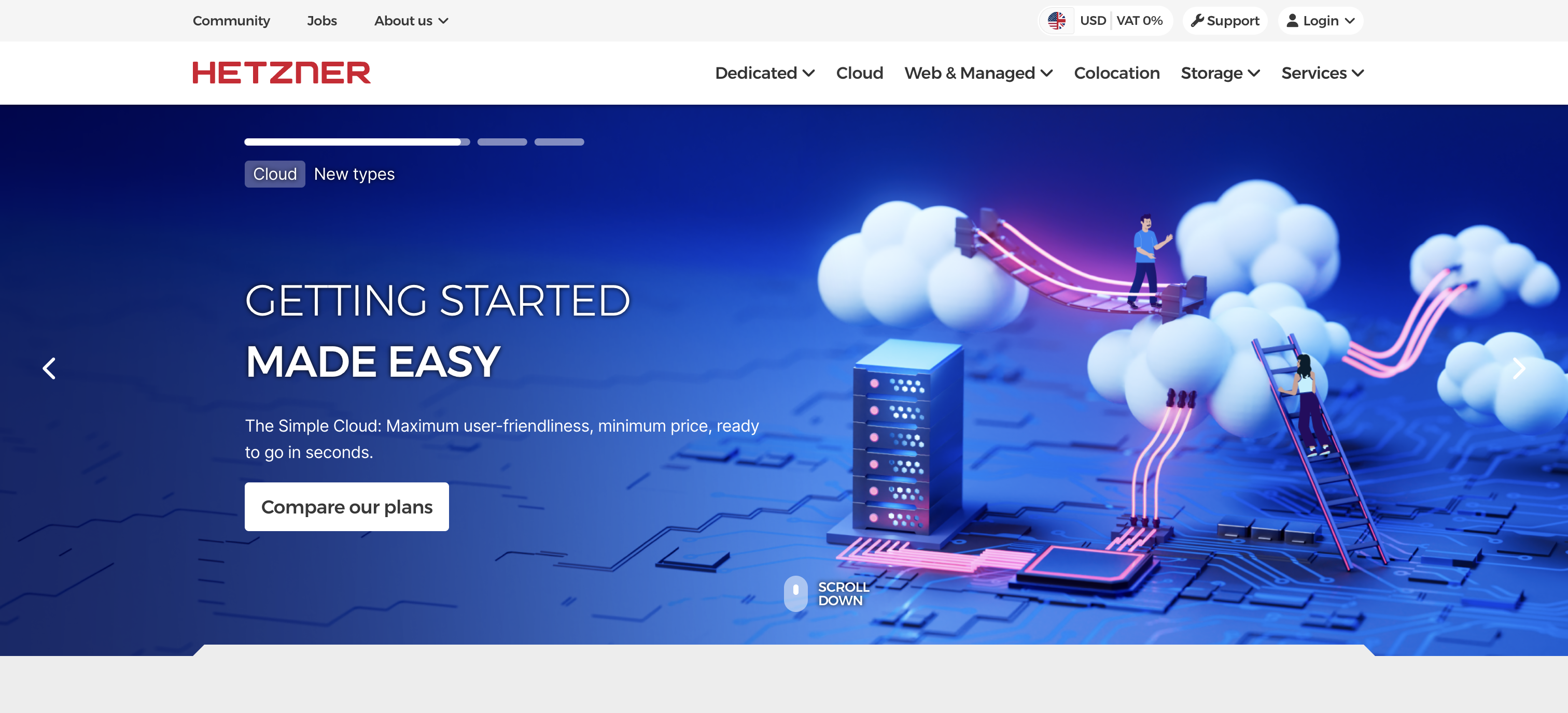
Hetzner is a German cloud infrastructure provider that offers cost-effective bare metal dedicated servers and virtual private servers, positioning itself as the budget-friendly European alternative for developers and businesses willing to manage their own infrastructure with minimal managed services. Hetzner offers Cloud Servers (virtual machines) across multiple tiers including CX (cost-optimized shared vCPUs), CPX (regular performance AMD EPYC), CAX (ARM-based Ampere processors), and CCX (dedicated vCPUs for production workloads), Block Storage volumes with network-attached SSD storage, Object Storage with S3-compatible APIs (recently launched), Load Balancers for traffic distribution, and Volumes for persistent storage. Notably, they lack managed databases, managed Kubernetes, or any PaaS offerings that competitors provide.
For AI and machine learning workloads, Hetzner provides dedicated GPU Servers, including the GEX44 with NVIDIA RTX 4000 SFF Ada Generation (20GB GDDR6 ECC) and GEX130 with NVIDIA RTX 6000 Ada, available as bare metal dedicated servers rather than cloud instances. This bare-metal-only approach means more hands-on setup and maintenance—a potential barrier if you’re looking for on-demand cloud GPUs or don’t have deep infrastructure experience
Hetzner key features:
-
Multiple processor architectures (Intel Xeon, AMD EPYC, ARM Ampere) with NVMe SSD storage, 20 TB included bandwidth in EU locations, instant provisioning under 60 seconds, and built-in DDoS protection with cloud firewalls
-
Cloud Networks for VPC isolation, Floating IPs for high availability, automated Snapshots and Backups, and a comprehensive REST API
-
Official Terraform provider for infrastructure-as-code deployments
-
GDPR-compliant infrastructure with data centers in Germany, Finland, US, and Singapore, adhering to European data protection standards
Hetzner pricing:
-
Cloud Servers: $4.09/month starting for CX23 cost-optimized shared vCPU instances with 2 vCPUs, 4 GB RAM, 40 GB NVMe SSD, and 20 TB included traffic
-
Dedicated GPU Servers: $205/month plus $88 setup fee starting for NVIDIA RTX 4000 SFF Ada (GEX44)
With no native managed databases, Kubernetes, or PaaS options, Hetzner’s budget-friendly compute requires more hands-on infrastructure management as you scale. Discover which Hetzner alternatives offer comprehensive managed services, broader global reach, and 24/7 support your business demands.
Hyperscaler providers
Hyperscaler clouds—AWS, Google Cloud, Azure, plus IBM Cloud and Alibaba Cloud—offer extensive service portfolios and global infrastructure across dozens of regions. But they’ve earned a reputation for complexity, with steep learning curves and billing structures that lead to surprise charges from data egress and premium support tiers. For organizations with dedicated cloud engineering teams, the feature depth can justify the overhead, but these setups can be challenging to navigate for smaller teams.
7. Amazon Web Services (AWS) for enterprise-scale feature depth
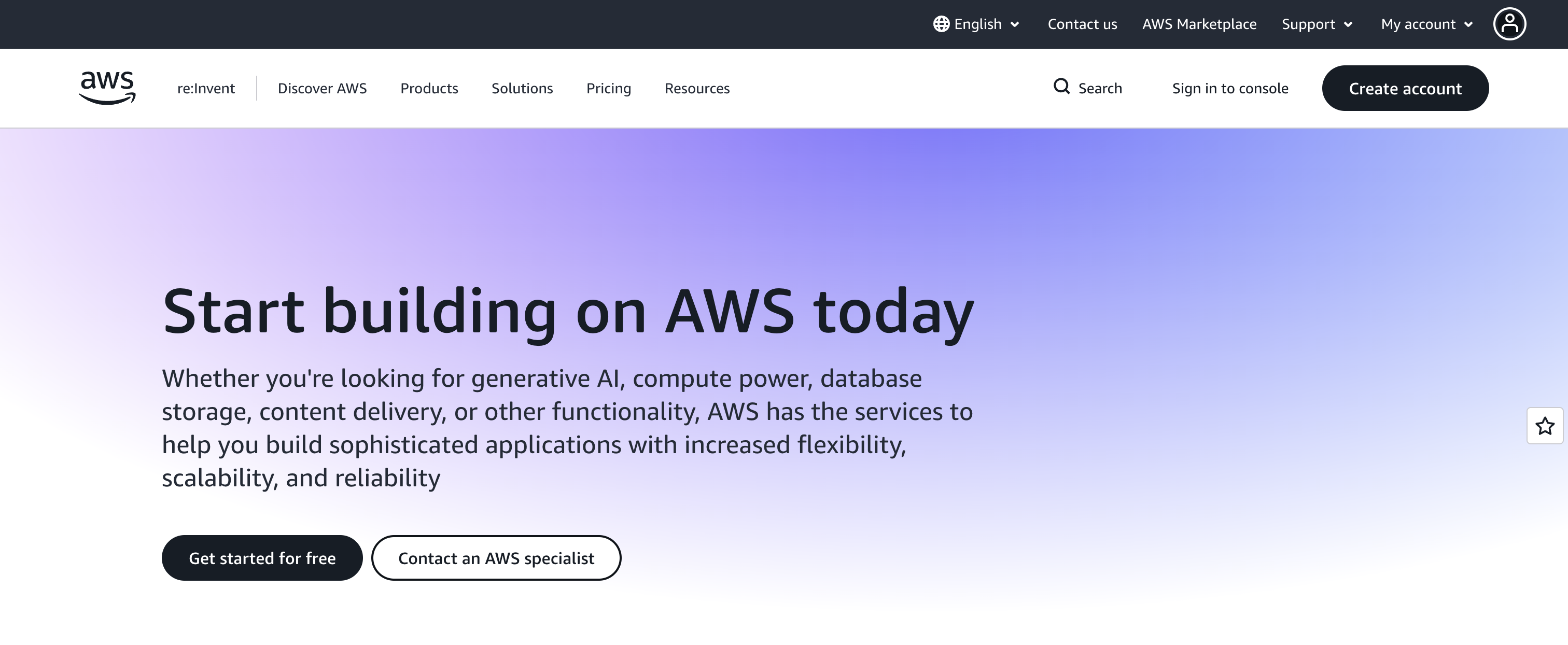
AWS is the world’s largest cloud infrastructure provider, launching EC2 in 2006. They offer over 200 fully-featured services spanning compute, storage, databases, analytics, and AI/ML. AWS demands substantially more DevOps expertise and ongoing cost management effort than many specialized providers because it’s built for enterprises with dedicated cloud teams, rather than lean startups and digital-native enterprises seeking fast deployment and predictable costs. The platform offers EC2 (Elastic Compute Cloud) virtual machines in dozens of instance families optimized for every workload, from burstable general purpose to compute-intensive applications. Users also have access to S3 object storage, RDS managed databases for MySQL, PostgreSQL, MariaDB, Oracle, and SQL Server, and EKS (Elastic Kubernetes Service) for container orchestration. Building and deploying apps? App Runner is AWS’ fully managed PaaS that deploys containerized web applications directly from source code or container images with automatic scaling and built-in load balancing.
For AI and machine learning workloads, AWS provides Amazon Bedrock for accessing models from leading providers, including Anthropic Claude, Meta Llama, and Amazon Titan, through simple APIs, Amazon SageMaker AI as a comprehensive platform for building, training, and deploying custom ML models, plus P5 GPU instances.
AWS key features:
-
Over 750 EC2 instance types across Intel, AMD, and ARM (Graviton) processors with per-second billing and multiple pricing models
-
P5 instances with 8x NVIDIA H100 GPUs per node, 3,200 Gbps EFA networking, and EC2 UltraClusters
-
Amazon Bedrock with hundreds of foundation models plus AgentCore for deploying production AI agents with enterprise-grade memory, identity, and tool integration
-
Global infrastructure across 30+ regions with 99.99% SLA, VPC networking, DDoS protection, and compliance certifications, including SOC, HIPAA, and GDPR
AWS pricing:
-
EC2 instances: $6.13/month for t4g.micro shared instance with 2 vCPUs, 1 GB RAM, EBS-only storage, and up to 5 Gbps network
-
App Runner: $0.007/vCPU-hour and $0.007/GB-hour starting for active container instances, with configurations ranging from 0.25 vCPU/0.5 GB to 4 vCPU/8 GB
-
GPU instances: $6.88/hour on-demand for p5.4xlarge GPU instance with 16 vCPUs, 256 GiB RAM, 100 Gigabit network, and 1x 3840 GB SSD
With over 200 services, unclear pricing that leads to surprise bills, and support geared toward enterprises, AWS’s complexity can overwhelm teams that just need reliable, straightforward cloud hosting. Find out which AWS alternatives offer transparent pricing, simpler interfaces, and the focused feature sets growing businesses actually need.
8. Google Cloud Platform (GCP) for data analytics and machine learning
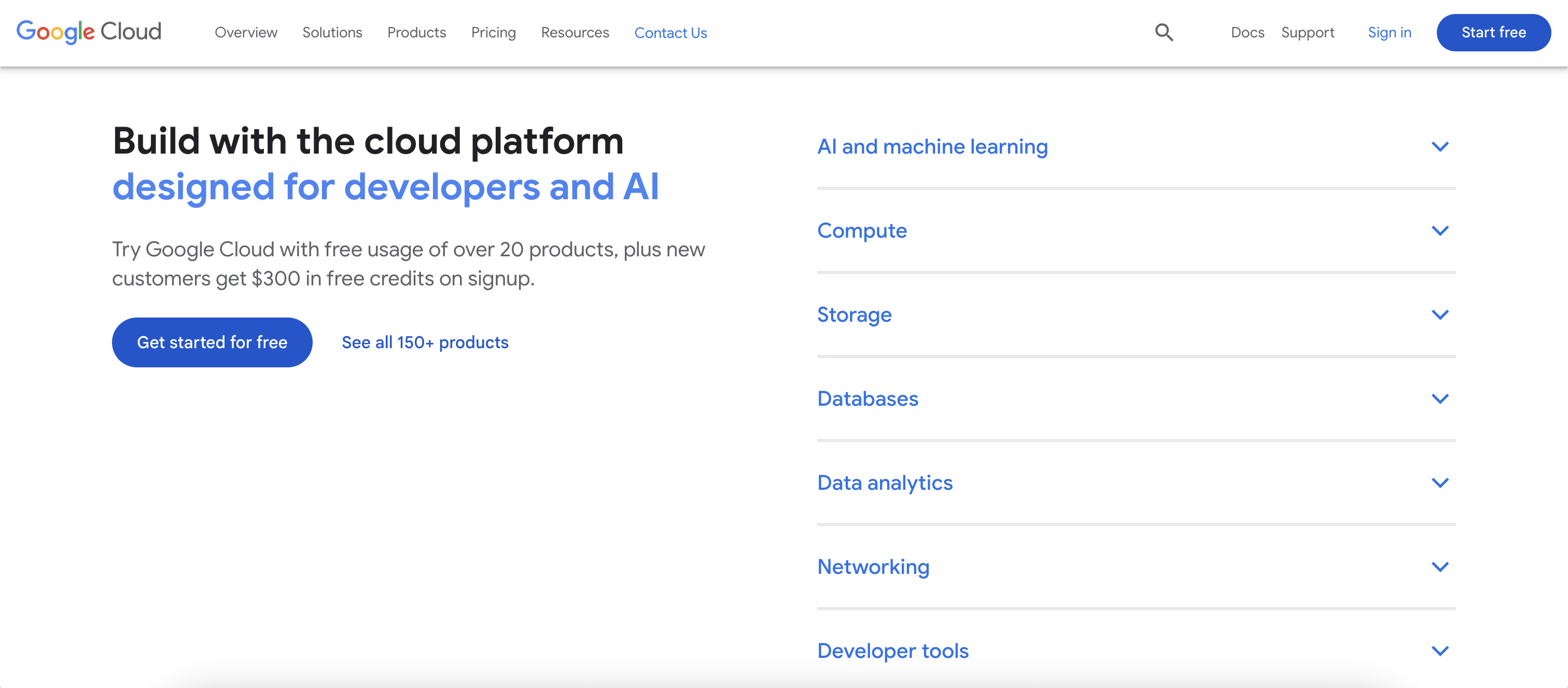
Google Cloud Platform (GCP), Google’s enterprise cloud computing platform, has built its reputation on data analytics, machine learning capabilities, and its global network infrastructure. However, GCP shares the hyperscaler complexity challenges of AWS and Azure: it’s extensive service catalog requires significant expertise to navigate, pricing models with sustained use discounts and committed use contracts can be confusing, and egress fees add unpredictability to monthly bills. The platform offers Compute Engine virtual machines across general-purpose, compute-optimized, and memory-optimized configurations with per-second billing, Cloud Storage for object storage, Cloud SQL and AlloyDB managed databases for MySQL, PostgreSQL, and SQL Server, Google Kubernetes Engine (GKE) for container orchestration, and Cloud Run as a fully managed serverless platform that deploys containerized applications. Additionally, GCP offers App Engine as a traditional PaaS offering with automatic scaling and built-in application services for deploying web applications and APIs.
GCP provides Vertex AI as a unified platform for building and deploying AI applications with access to Gemini models, Anthropic Claude, Meta Llama, and 200+ foundation models in Model Garden, plus A3 GPU instances powered by NVIDIA H100 and H200 GPUs with TPU v5p accelerators.
GCP key features:
-
Compute Engine VMs across Intel, AMD, and ARM (Tau) processors
-
BigQuery serverless data warehouse for petabyte-scale analytics with built-in ML capabilities, real-time streaming, and native Gemini AI integration for natural language querying
-
Cross-cloud analytics through BigQuery Omni, allowing you to run queries on data stored in AWS or Azure without the need for moving it
-
Global infrastructure across 35+ regions with automatic network tiering, VPC networking, Cloud Armor DDoS protection, and compliance certifications, including SOC, HIPAA, and FedRAMP
GCP pricing:
-
Compute Engine: $6.11/month for e2-micro shared instance with 2 vCPUs and 1 GiB RAM
-
App Engine: $0.05–$0.10/hour per instance, depending on environment (Standard or Flexible) and instance class, with free tier quotas available
-
GPU instances: $88.49/hour on-demand for A3-highgpu-8g instance with 8 GPUs, 208 vCPUs, and 1872 GiB RAM
Google Cloud Platform excels at big data and machine learning, but its steep learning curve and costs can leave smaller teams paying enterprise prices for features they’ll never use. See which Google Cloud alternatives deliver the infrastructure you need without requiring a dedicated cloud specialist to manage it.
9. IBM Cloud for regulated industries and hybrid deployments
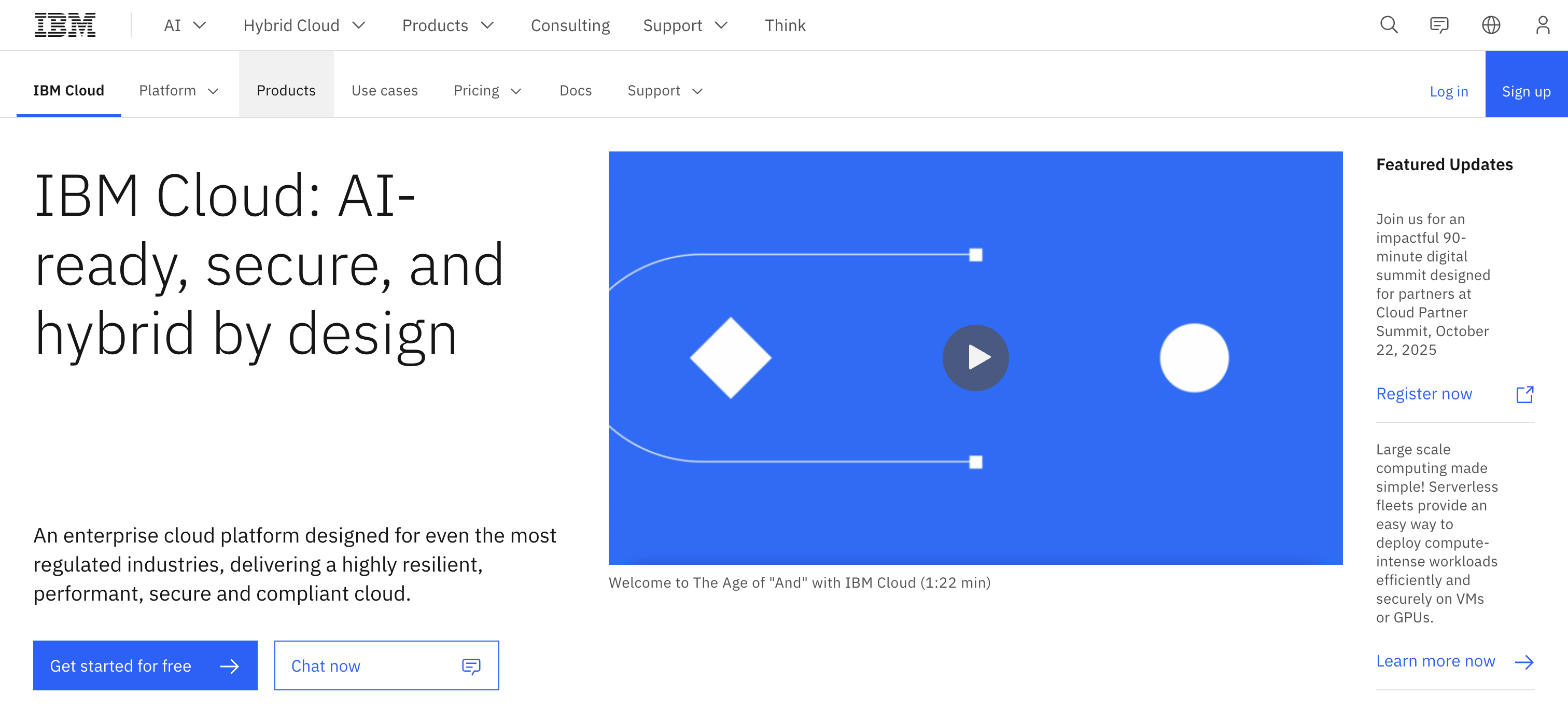
IBM Cloud is an enterprise-focused cloud computing platform that has positioned itself as the hybrid cloud option for highly regulated industries. It offers a secure and compliant foundation for financial services, healthcare, government, and telecommunications organizations that require strict data sovereignty and mission-critical reliability. The platform offers Virtual Servers for VPC with Intel Xeon, AMD EPYC, and ARM processors across Balanced, Compute, Memory, and GPU-optimized profiles, Cloud Object Storage with S3 compatibility, Managed Databases for PostgreSQL, MySQL, MongoDB, and Redis, IBM Cloud Kubernetes Service for container orchestration, and Code Engine as a fully managed serverless platform built on Kubernetes and Knative that deploys containerized applications, batch jobs, and functions with automatic scaling to zero.
IBM Cloud provides a GPU catalog that includes NVIDIA H100, H200, A100, L40S, and AMD MI300X GPUs, along with Intel Gaudi 3 accelerators. Plus, they offer the watsonx.ai platform for building, training, and deploying AI models with access to IBM Granite, Meta Llama, and other foundation models through a unified AI studio, and watsonx.governance for end-to-end AI lifecycle tracking and regulatory compliance.
IBM Cloud key features:
-
Virtual Servers for VPC with provisioning, up to 80 Gbps networking, per-second billing, and 99.99% uptime SLA
-
Bare metal servers with over 11M configuration combinations and 20 TB of included outbound bandwidth
-
Multizone regions with three availability zones per region across 60+ global data centers
-
Industry-specific compliance controls (SOC 2, HIPAA, FedRAMP, PCI DSS, GDPR) with confidential computing and KYOK/BYOK encryption
IBM Cloud pricing:
-
Virtual Servers for VPC: $53.29/month for nxf-2x1 Flex instance with 2 vCPUs, 1 GB RAM, and 2 Gbps bandwidth
-
GPU instances: $85.00/hour for GPU virtual server instance with 8x H100 GPUs, 160 vCPUs, 1792 GiB RAM, 61440 GB storage, and 200 Gbps network
10. Alibaba Cloud for Asia-Pacific market reach
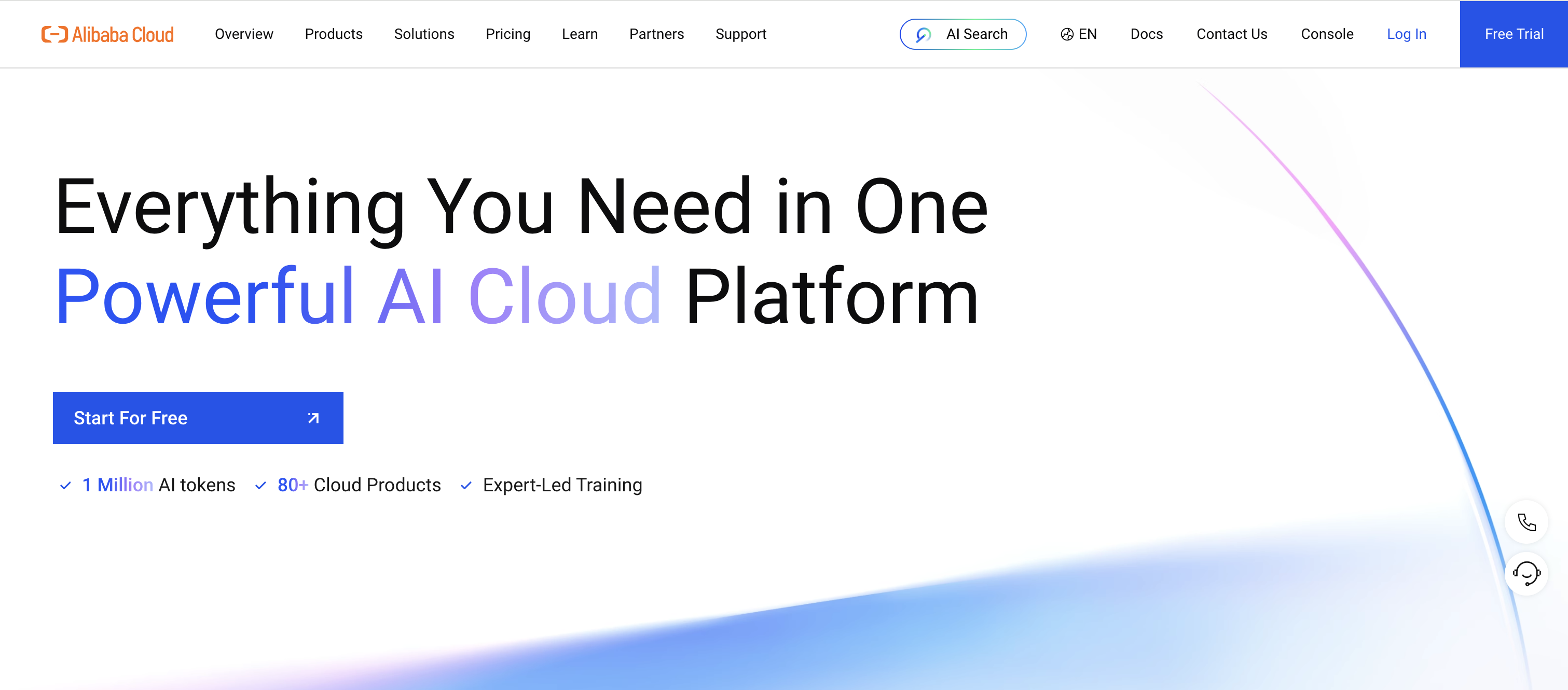
Alibaba Cloud is the largest cloud provider in Asia Pacific. Businesses targeting Asian markets gravitate toward Alibaba Cloud for its regional infrastructure with 29 regions and 92 availability zones, competitive pricing that often undercuts Western hyperscalers, and deep integration with China’s regulatory requirements for data residency and compliance. The platform offers Elastic Compute Service (ECS) with Intel Xeon and AMD EPYC processors across general-purpose, compute-optimized, and memory-optimized configurations, Object Storage Service (OSS) with S3 compatibility, ApsaraDB managed databases for MySQL, PostgreSQL, MongoDB, Redis, and PolarDB (Alibaba’s cloud-native database), Container Service for Kubernetes (ACK), Serverless App Engine (SAE) as an application-oriented serverless PaaS supporting Spring Cloud and Dubbo microservices, and Function Compute for event-driven serverless functions.
Alibaba Cloud provides an extensive Elastic GPU Service including NVIDIA H100, A100, L40S, L20, T4, and V100 GPUs, the Platform for AI (PAI) comprehensive ML platform with PAI-DSW notebooks, PAI-EAS model deployment, and PAI-DLC distributed training, plus the Qwen model family—Alibaba’s open-source foundation models with over 400 million downloads that compete directly with GPT-4o and Claude in benchmarks.
Alibaba Cloud key features:
-
ESSD cloud disks with up to 1 million IOPS per disk, eRDMA networking with 8-microsecond latency, and packet forwarding rates up to 30 million pps on 8-GPU instances
-
vGPU support with fractional GPU allocation (1/4, 1/2, 1/6 partitions) for cost-effective inference, plus confidential computing (gn8v-tee) for secure LLM training
-
ISO 27001 and MTCS certifications, and VPC isolation with Anti-DDoS protection included on all instances
-
Multi-language support across 119 languages in Qwen3 models, with hybrid reasoning capabilities and 128K token context windows
Alibaba Cloud pricing:
-
ECS instances: $4.55/month starting for economy instance e with 2 cores, 0.5G memory, 40 G Standard ESSD, and 200Mbps bandwidth
-
Serverless App Engine: $0.000006859/CU starting for pay-as-you-go, or $6.85/year starting for resource plans with 1 million CU
-
GPU instances: $2.26/hour for ecs.gn8is.2xlarge GPU-accelerated compute-optimized instance with 8 vCPUs and 64 GiB RAM
All pricing information in this article is accurate as of December 5, 2025. For the most current pricing details, please visit each provider’s official website directly. Pricing reflects standard, publicly posted rates and does not include potential discounts, volume pricing, or savings plans that may be available.
Azure alternatives FAQs
What are the main reasons companies switch from Azure to specialized providers?
Companies often migrate due to Azure’s pricing complexity, unexpected bills from hidden costs like data egress and support tiers, and the steep learning curve required to navigate its extensive service catalog. Specialized providers, such as DigitalOcean, offer more transparent pricing, simpler interfaces, and faster deployment times without compromising the core infrastructure capabilities that most applications require.
Which cloud providers offer better pricing transparency than Azure?
Providers like DigitalOcean offer straightforward pricing models with clear per-resource costs and no hidden egress fees—you see exactly what you’ll pay upfront. Unlike Azure’s complex calculator, which incurs separate charges for compute, storage, bandwidth, premium support tiers, and numerous add-ons, alternative providers simplify billing with included bandwidth allowances and predictable monthly costs.
What’s the difference between Microsoft Azure and DigitalOcean?
Azure is a hyperscaler designed for large enterprises with thousands of services and complex pricing tiers, whereas DigitalOcean focuses on simplicity with curated infrastructure services tailored for startups and digital-native enterprises. DigitalOcean offers faster time-to-deployment with straightforward documentation and interfaces, whereas Azure provides deeper enterprise features and global scale at the cost of significantly higher complexity.
Can I get similar performance to Azure at a lower cost?
Yes, alternative providers often deliver comparable performance for standard workloads at significantly lower price points, particularly for compute and storage resources. DigitalOcean’s Droplets, for example, offer transparent pricing starting at $4/month with compute, storage, and bandwidth included, versus Azure’s complex per-resource billing that can quickly escalate.
What should I consider when evaluating Azure alternatives for AI workloads?
Compare GPU pricing across providers—Azure and other hyperscalers tend to price H100 instances at a premium, while AI-focused providers often offer more competitive rates. Also consider whether you require the complexity of Azure’s full AI Foundry platform or if your workloads can run on simpler GPU infrastructure with standard ML frameworks and tools.
DigitalOcean: The Azure alternative your business needs
If you’re frustrated with Azure’s complexity, unpredictable billing, and the need for specialized DevOps resources just to maintain your infrastructure, DigitalOcean offers a compelling alternative.
Sans Paper, an Australia-based construction software provider, made the switch from Azure and achieved 30% cost savings while eliminating the need for dedicated DevOps staff. As their CTO Gim Wee puts it: “The documentation for Azure is not great. You probably need specialized DevOps that knows Azure, how to set it up, and how to maintain that. That’s going to cost the business.”
Why teams choose DigitalOcean over Azure:
-
Transparent, predictable pricing with no hidden egress fees or surprise charges—see exactly what you’ll pay before you deploy
-
Intuitive interface and excellent documentation that empowers your entire technical team, not just cloud specialists
-
Fast deployment times with Droplets that spin up in seconds, plus easy cloning and snapshots for rapid testing and rollback
-
Comprehensive product suite including App Platform for deploying apps directly from Git, managed Kubernetes, databases (PostgreSQL, MySQL, MongoDB, Redis, Kafka), object storage, load balancers, and VPC networking—everything you need without navigating thousands of services
-
Gradient™ AI Agentic Cloud for building and deploying AI agents on GPU-powered infrastructure with GPU Droplets (single or 8-GPU configurations), Bare Metal GPUs for multi-node clusters, and 1-Click Models for deploying third-party generative AI models
-
All-inclusive bandwidth and straightforward per-resource costs that simplify budgeting and reduce total infrastructure spend
-
Responsive support when you need it, backed by comprehensive tutorials and community resources
-
Global infrastructure with data centers strategically located for low latency without enterprise-level complexity or pricing
Get started with DigitalOcean today and join thousands of developers and businesses who’ve simplified their cloud infrastructure without sacrificing performance.
About the author

Fadeke Adegbuyi is a Manager of Content Marketing at DigitalOcean. With 8 years in the technology industry, she leads content strategy and development, creating resources for developers and technical decision makers. She writes about AI/ML and cloud computing—covering everything from prompt engineering best practices to the best cloud monitoring tools.
Get started for free
Sign up and get $200 in credit for your first 60 days with DigitalOcean.*

*This promotional offer applies to new accounts only.